
Laos is a landlocked country in mainland Southeast Asia, bordered by Thailand, Cambodia, Vietnam, China, and Myanmar. With a total land area of approximately 236,800 square kilometers, more than 70 percent of its surface is covered by mountains or upland hills. These physical characteristics combined with high annual rainfall and large catchments within the country draining into the Mekong make geography a key factor in hydropower development.
The country lies entirely within the Mekong River Basin, and most rivers originate in the eastern and northern highlands before flowing westward or southward into the Mekong. This topographic pattern creates varied hydropower conditions across the country.
Regional Overview
Northern Highlands
Provinces such as Phongsaly, Luang Namtha, and Oudomxay are characterized by steep mountain ranges, narrow valleys, and high rainfall. Nam Ou system bring the prominent rivers with this region, descends quickly and has been developed into a run-of-river cascade of hydropower projects
Xieng Khouang Plateau
This elevated region spans Xieng Khouang and parts of northern Bolikhamxay. The Nam Ngum and Nam Ngiep rivers both originate here, flowing southwest through increasingly narrow valleys toward the Mekong. Hydropower projects in this region include the Nam Ngum cascade (Nam Ngum 1, 2, 3, 5) and the Nam Ngiep system. The plateau is also known for its cooler climate, expansive grasslands, and significant UXO contamination from past conflicts, there is small section in the northeast of the country that drains west towards Vietnam, outside of the Mekong’s catchment.
Central Uplands and Nakai Region
Further south, the provinces of Khammouane and central Bolikhamxay are defined by the Annamite Mountains and interior uplands. The Nakai Plateau forms a broad elevated area where the Nam Theun 2 project was developed, with water diverted westward into the Xe Bang Fai Basin. This region features both steep river valleys and broader storage basins, depending on location.
Southern Highlands and Bolaven Plateau
In Champasak, Attapeu, and Sekong, the landscape is dominated by the continuation of the Annamite Mountains and the Bolaven Plateau, a high-elevation volcanic formation with some of the heaviest rainfall in the country. Rivers like the Xeset, Xe Namnoy, and Xe Pian originate here. The Xe Pian–Xe Namnoy project utilizes both elevation and water volume to generate power before discharging into the transboundary Xe Kong system, which flows into Cambodia and Vietnam as part of the 3S system.
Climate and Flow Regimes
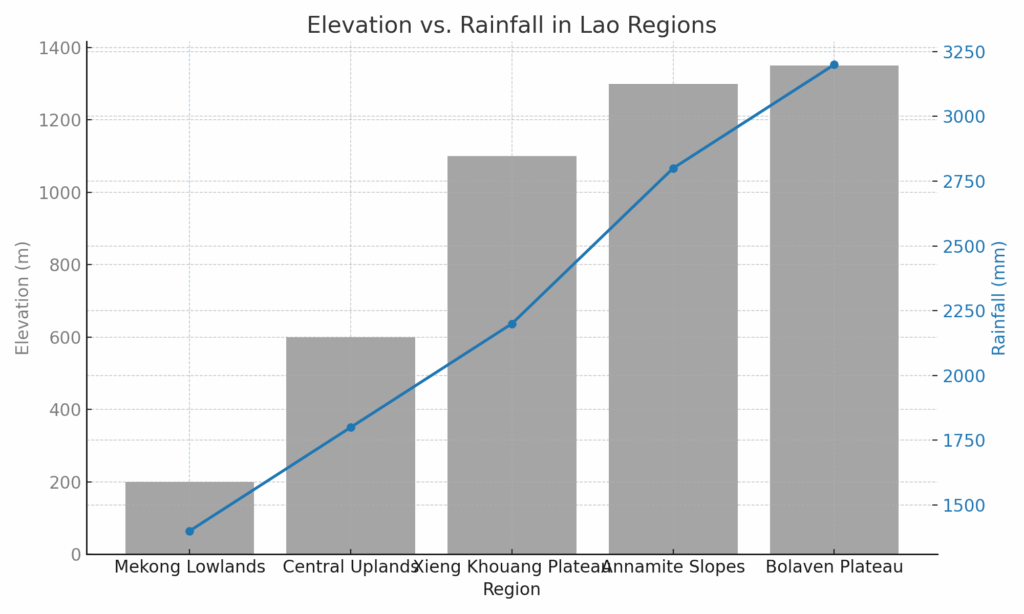
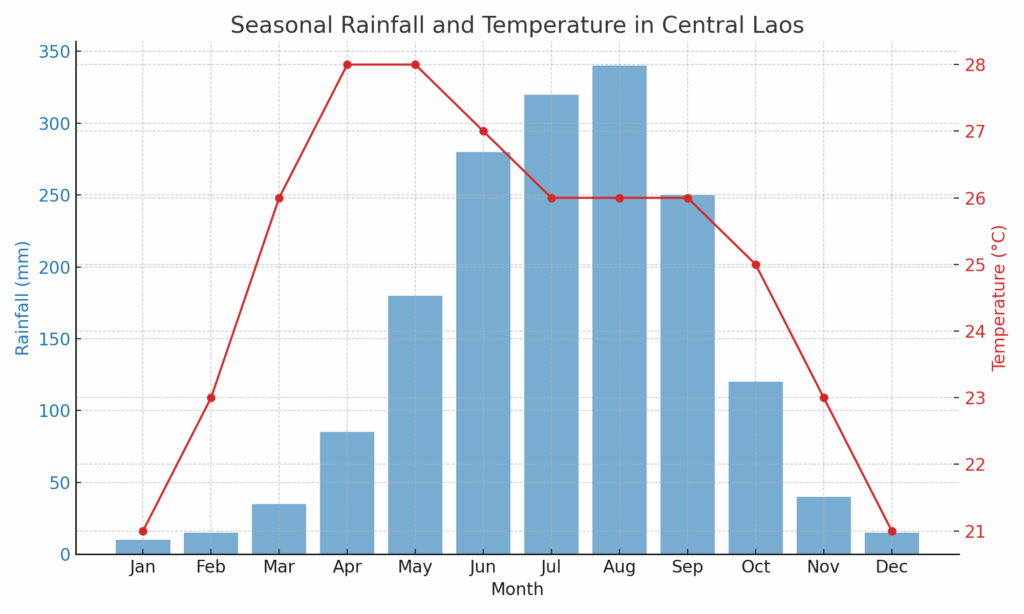
Laos has a tropical monsoon climate with a clear division between the wet season (May–October) and the dry season (November–April). Annual rainfall ranges from 1,300 mm to over 3,000 mm, depending on elevation and location. This creates significant seasonal flow variation in all major river systems, which must be considered in dam design, flood routing, sediment management, and reservoir operations.
Rainfall is strongly influenced by elevation and orographic effects. Moist air from the southwest monsoon is forced upward when it hits mountain ranges, cooling as it rises and releasing heavy rainfall on the windward slopes. As a result, higher-elevation areas tend to receive more rainfall, often in short, intense bursts.
Tropical storms, particularly in the late wet season, can deliver extreme rainfall over short periods. These events cause flash floods, landslides, and rapid rises in river levels—factors that must be incorporated into hydropower planning and risk management.
Conclusion
The geography of Laos—its plateaus, mountains, and river systems—forms the foundation for hydropower development. But each region has distinct features, from steep upland valleys to broad plateaus and cross-border watersheds. A clear understanding of this physical landscape is essential knowledge for anyone interested in the Lao energy sector.
