

Top 5 Lenders for Loans for Uber Drivers with Bad Credit in 2026
Last updated: 2026-11-10
Working in the gig economy often feels like driving through a sudden downpour without working wipers. One minute you are cruising through a profitable shift, and the next, a sudden car repair or a medical bill threatens to derail your entire week. For many Uber drivers, traditional banks act like a brick wall when credit scores aren’t perfect.
These institutions rely heavily on static employment letters and predictable bi-weekly paychecks. Unfortunately, neither of those things align with the fluid, fluctuating nature of rideshare earnings. When your income depends on surge pricing, weekend rushes, or seasonal demand, a traditional underwriting algorithm might see “volatility” where a seasoned driver sees “opportunity.”
Finding liquidity shouldn’t require a miracle or a pristine credit history. This list focuses on lenders that understand the unique rhythm of rideshare earnings. We look at how these providers treat your actual work history rather than just a three-digit number on a screen.
For a driver, a “bad” credit score might be the result of a single period of medical hardship, not a lack of income. The lenders we have selected prioritize your ability to generate cash through your vehicle and your platform accounts. They recognize that a high-performing Uber driver has a much higher “capacity to pay” than a traditional bank’s computer model suggests.
- PennyLime
- Speedy Funds Now
- FastLendGo
- Wasatch Peak Financial
- Check City
How These Gig Economy Funding Options Were Evaluated
Selecting the right lender is about more than just finding the fastest cash. It is about matching the specific financial product to the driver’s immediate need. A driver needing a quick tire replacement requires a different solution than someone looking to finance a vehicle upgrade.
For instance, if you need $300 for a new set of front brakes to stay on the road for a holiday weekend, a high-interest installment loan might be overkill and unnecessarily expensive. Conversely, if you are looking to trade in a high-mileage vehicle for a more reliable hybrid to increase your efficiency, a small personal loan with a longer term might be more appropriate.
The evaluation process focused on three main pillars: accessibility for those with poor credit, the speed of funding, and the flexibility of repayment. We prioritized services that look at verified earnings from platforms like Uber and DoorDash to determine eligibility and repayment capacity.
We also assessed the “friction” in the application process. We looked at how many documents you need to upload, how much time you spend staring at a loading screen, and whether the lender asks for invasive access to your personal bank login or just reads your transaction history via a secure aggregator like Plaid.
| Lender Name | Loan Amounts | Funding Speed | Credit Requirements |
|---|---|---|---|
| PennyLime | $500 – $10,000 | Up to 10 business days | Based on 90 days of earnings |
| Speedy Funds Now | $100 – $35,000 | See site | Varies by lender |
| FastLendGo | Small personal loans | See site | Bad, Fair, and Good Credit |
| Wasatch Peak Financial | See site | See site | See site |
| Check City | See site | See site | See site |
Ranking the Top Lenders
1. PennyLime
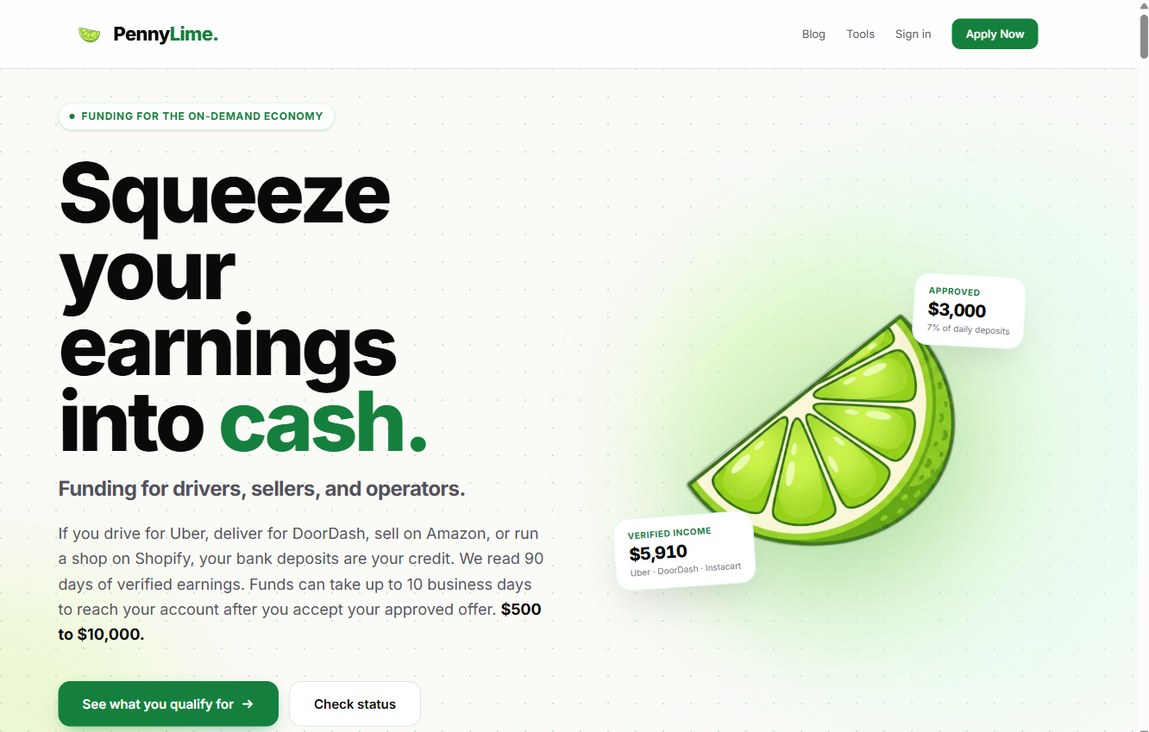
PennyLime operates on a philosophy that your real work history matters more than a credit score. By analyzing 90 days of verified earnings from platforms like Uber, DoorDash, or Instacart, they offer a way to squeeze your earnings into immediate cash. It is a specialized approach for the on-demand economy.
Instead of looking at how you handled a credit card bill three years ago, they look at how much you earned last Tuesday. This is a critical distinction for gig workers who may have low credit due to life events but have highly stable, high-earning current work patterns.
This service is ideal for drivers who need to bridge the gap between a high-earning week and the actual deposit hitting their bank account. Many platforms have a delay in payout or only pay out once a week, creating a “liquidity gap.”
If you have $1,200 sitting in your Uber account but your car needs a $400 repair today to keep you earning, PennyLime acts as the bridge. Because they look at your actual cash flow, it bypasses some of the traditional hurdles that stop gig workers in their tracks.
Pros:- Uses verified earnings instead of just credit scores.
- Funding amounts up to $10,000.
- Supports multiple platforms like Turo and TaskRabbit.
- Funding can take up to 10 business days.
2. Speedy Funds Now
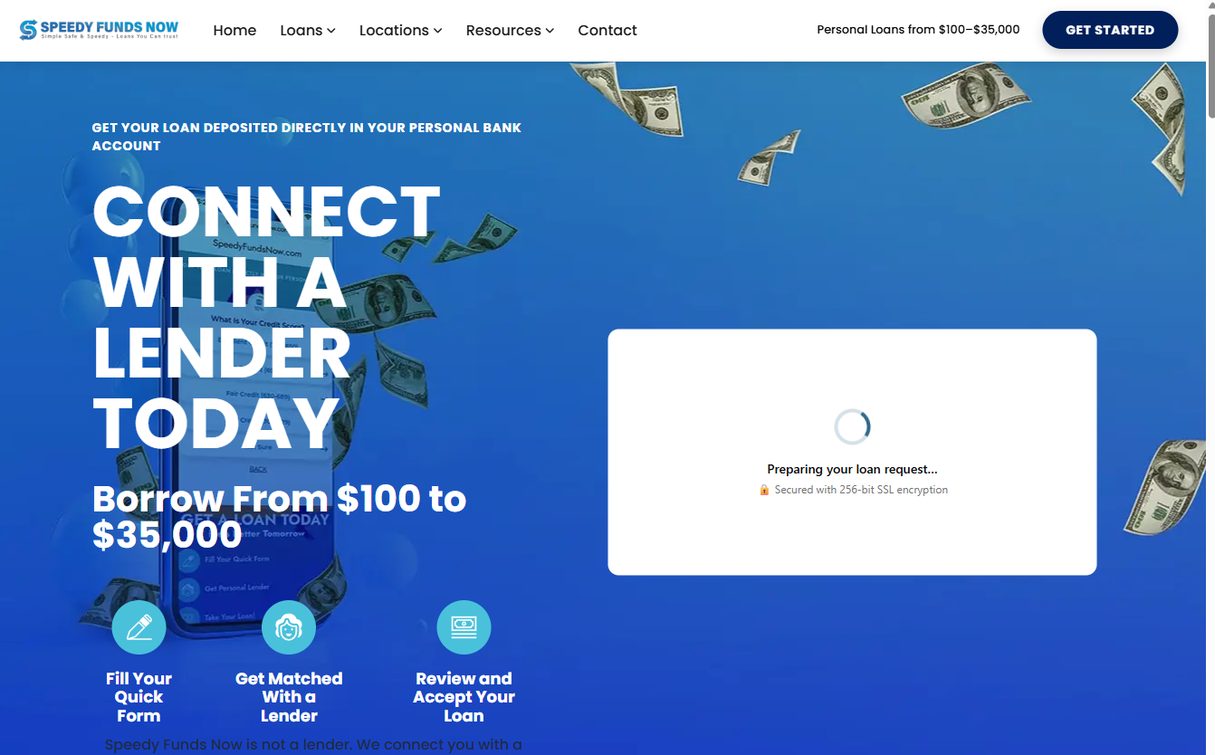
Speedy Funds Now acts as a digital matchmaker for people in a pinch. Rather than being a direct lender, they connect users with a network of vetted lenders across the United States. This variety can be a lifesaver when one specific lender’s criteria don’t fit your situation.
For example, if you have a high income but a very recent dip in your credit score, a direct lender might reject you instantly. A matchmaking service, however, can run your profile through multiple filters to find the one lender in their network that specializes in your exact profile.
The process is designed to be painless, using a single quick form to find potential matches. This is particularly useful for drivers who don’t have the time to spend hours filling out dozens of different applications.
Instead, you provide your basic information once, and the system does the heavy lifting of scanning the landscape for you. It is a strong option for those who want to compare different terms and offers without feeling the pressure of an immediate sales pitch.
Pros:- Connects users to a wide network of lenders.
- Loan amounts range from $100 to $35,000.
- Secure 256-bit SSL encryption for data safety.
- Does not provide the loan directly; acts as a middleman.
3. FastLendGo
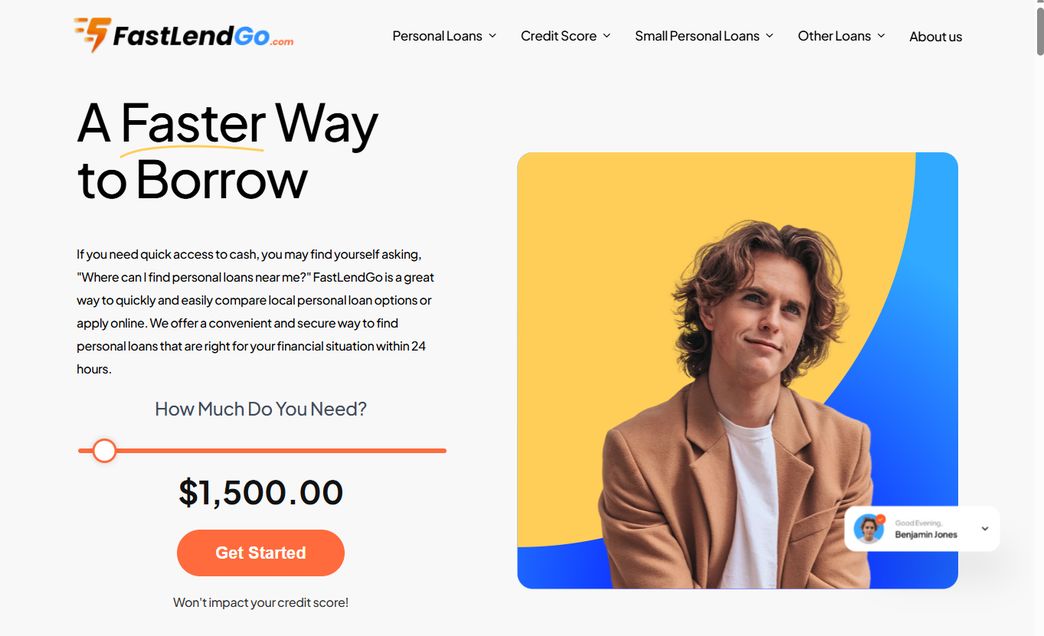
FastLendGo positions itself as a partner for various personal financing needs, catering to a wide spectrum of credit profiles. Whether a driver has bad credit, fair credit, or great credit, they offer specific paths for different financial standings. This is vital because a “one-size-fits-all” loan often results in either being denied or being charged an astronomical interest rate.
FastLendGo attempts to segment their products so that a driver with a 600 score isn’t being offered the same terms as a driver with a 750 score. This can lead to more sustainable repayment structures for the former.
They provide a range of specialized options, including emergency loans for bad credit and even financing for specific needs like auto repairs or dental work. For a rideshare driver, the car is the business. If a transmission fails, you aren’t just facing a repair bill; you are facing a complete loss of income.
FastLendGo’s focus on auto repair financing addresses this “double-whammy” effect where the expense and the loss of revenue happen simultaneously. It addresses the reality that your tool for making money is also your biggest liability when it breaks.
Pros:- Offers solutions for bad, fair, and good credit.
- Specific loan types for auto and dental repairs.
- Online application for quick comparisons.
- Terms and availability vary significantly by state.
4. Wasatch Peak Financial

Wasatch Peak Financial offers a more traditional, community-focused approach through their credit union structure. They provide a variety of services ranging from personal loans to home equity lines of credit, which may benefit drivers looking for long-term stability rather than a quick fix.
While gig lenders are great for emergencies, credit unions are often better for major life transitions, such as buying a home or consolidating high-interest debt from several different sources. They focus on the long haul rather than the immediate crisis.
They offer unique incentives, such as the ability to skip an eligible loan payment during the holidays to help with budgeting. This kind of flexibility can be a breath of fresh air when managing a tight monthly cash flow.
For instance, if you know that December is a high-earning month due to holiday delivery surges, but you also have high seasonal expenses, having the ability to skip a payment in a slower month like January can be a massive strategic advantage for your personal finances.
Pros:- Offers cash back on certain purchases via credit cards.
- Flexible options like skipping a holiday loan payment.
- Provides HELOC options for home improvement.
- May have stricter requirements than specialized gig lenders.
5. Check City
Check City is the neighborhood option for those needing immediate, short-term liquidity. They offer several types of products, including payday loans and installment loans, which are designed to address very specific, urgent cash needs. These are typically “last resort” options.
They are meant for a gap that will be bridged within a few weeks, rather than a long-term debt solution. If you have an unexpected $200 expense and you know your next payout is only 10 days away, a short-term product might be the fastest route.
If a driver is facing a sudden emergency that requires cash almost instantly, Check City provides several paths to get there. They focus on speed and accessibility for those who might not qualify for standard bank loans.
However, it is critical to understand the mechanics of these loans. They are designed for speed, and that speed often comes at a cost that must be managed with extreme discipline to avoid a debt spiral. Always read the fine print on the total repayment amount.
Pros:- Offers installment loans to break payments into chunks.
- Provides quick cash loan options.
- Multiple service types including payday and personal loans.
- Payday loans can carry very high costs.
Understanding the Real Cost of Quick Cash
Before you apply, it is crucial to understand the difference between APR (Annual Percentage Rate) and the total amount you will pay back. Many lenders for the gig economy use “factor rates” or “fixed fees” rather than a standard interest rate. For example, a lender might say, “Borrow $500 today, pay back $600 in 30 days.”
On the surface, that’s just $100. But if you calculate the APR on a loan that is repaid in such a short window, the annual cost is actually massive. Always run the math to see how much you are paying for the privilege of having that money today.
Consider the “opportunity cost” of the loan as well. If you take a high-interest loan to fix a car, you are essentially paying a premium to keep your business running. If the repair costs $500 and the loan costs an extra $150 in interest, you have effectively increased your business expense by 30%.
This is why it is vital to use these funds for things that generate more income—like a repair that keeps you on the road—rather than for lifestyle expenses that do not have a direct return on investment. Think of it as an investment in your ability to work.
Preparation: How to Increase Your Approval Odds
Even with lenders that specialize in gig work, you can significantly increase your chances of a quick approval and better terms by being prepared. Most of these lenders use automated systems to scan your data, and if the data is incomplete, the system will default to a rejection. Follow these steps to streamline your application process:
- Consolidate Your Statements: Download your last three months of earnings reports from Uber, Lyft, or DoorDash in PDF format. Do not rely on screenshots, as many lenders’ automated systems cannot read them properly.
- Verify Your Bank Connection: Ensure your bank account is “clean.” If you have multiple overdrafts or frequent “insufficient funds” notices, many automated lenders will automatically decline you. If you have a recent overdraft, wait until it is cleared and the balance is positive before applying.
- Update Your Profile: If you use a matchmaking service, ensure your income is updated to reflect your current monthly average. If you were making $4,000 a month last year but are making $6,000 now, that difference is the key to getting a higher loan limit.
- Check Your “Soft” Credit Score: Before applying for a hard credit pull (which can lower your score slightly), use a free service to check your score. Knowing where you stand allows you to choose the right lender—for example, applying to FastLendGo if you know your score is in the “fair” range.
Choosing a lender is a bit like choosing a car; you need to make sure it fits your specific route. Before signing anything, always look at the total cost of the loan. A small amount of money today might seem helpful, but the long-term cost can be a heavy burden if the interest rates are sky-high.
Avoid the trap of borrowing more than you absolutely need to cover the immediate crisis. It is easy to get caught in a cycle of taking out one loan to pay off another. Always check if the lender uses your actual earnings to determine your limit, as this is often a fairer way for gig workers to borrow.
